
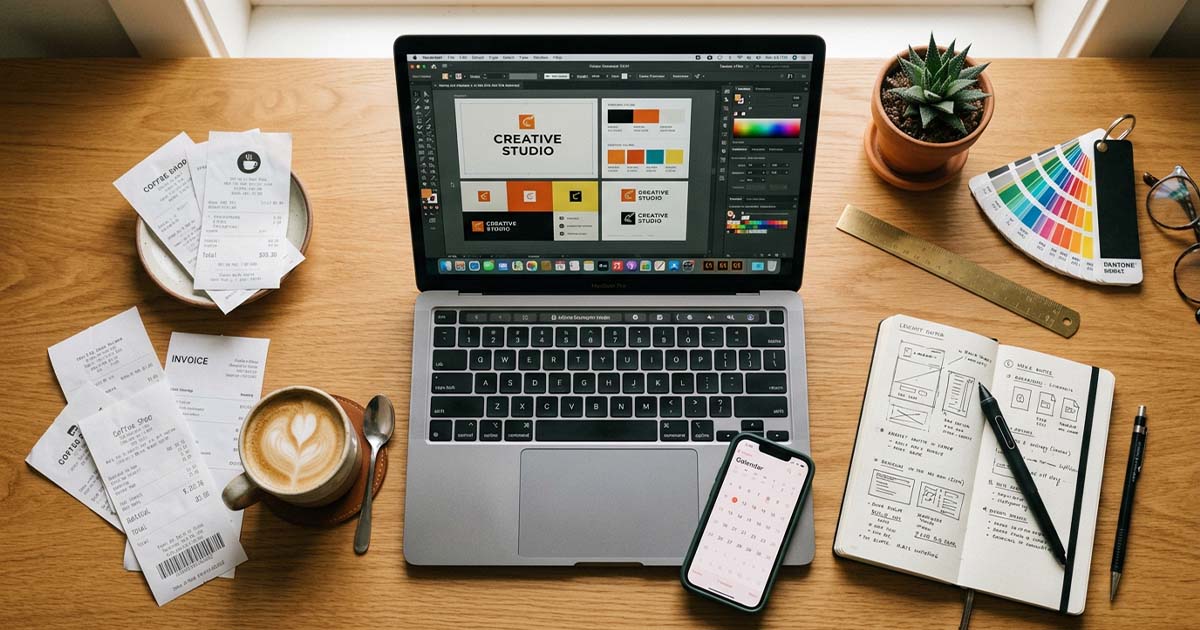
Business expenses reduce your taxable profit. That means every legitimate expense you claim saves you money — 20p in the pound if you're a basic rate taxpayer, 40p if you're higher rate, or 19p per pound saved in Corporation Tax if you're a limited company.
The rule HMRC uses is straightforward: expenses must be "wholly and exclusively" for business purposes. In practice, there's quite a lot that qualifies — and quite a few grey areas worth understanding. If you want to see exactly how these deductions affect your take-home pay, run your numbers through our interactive freelance calculator first.
Here's the full picture.
The categories you can claim
- Laptop, desktop, tablet or phone used for work
- External monitors, keyboards, mice, webcams
- Hard drives, USB hubs, cables and peripherals
- Headphones (if used for calls or work)
- Printer, scanner, or other office equipment
- Camera or recording equipment (if used for client work)
If a device is used for both work and personal use, you can claim the business-use proportion. A phone used 70% for work = 70% claimable.
- Adobe Creative Cloud, Figma, Sketch or other design tools
- Microsoft 365 or Google Workspace
- Project management tools — Notion, Linear, Asana
- Communication tools — Slack, Zoom
- Accounting software — QuickBooks, Xero, FreeAgent
- Cloud storage — Dropbox, Google Drive
- AI tools used for client work
- Domain names and web hosting
- Any SaaS subscription used in your work
- Simplified flat rate: HMRC allows £6/week (£312/year) without needing to calculate the actual proportion
- Actual costs method: Calculate what proportion of your home costs relate to business use — based on rooms used and hours worked — and claim that proportion of rent/mortgage interest, utilities, council tax, and broadband
- Home office furniture bought exclusively for work (desk, chair, lamp)
The flat rate is simple but modest. If you work from home full time, the actual costs method often yields a higher deduction — worth calculating with your accountant.
- Mileage for business travel in your own car — HMRC approved rate is 45p/mile for the first 10,000 miles, 25p/mile after
- Train, bus, tube, or taxi fares for business trips
- Flights for business travel
- Parking fees (not fines)
- Congestion charge for business journeys
- Bike mileage — 20p/mile
Commuting to a regular client site every day starts to look less like travel and more like a commute in HMRC's eyes — get advice if this applies to you.
- Online courses and training relevant to your work
- Books, guides, and reference materials
- Industry publications and magazine subscriptions
- Conference tickets and professional events
- Webinars and workshops
Training must relate to your existing work, not a new career. A developer learning a new framework: claimable. A developer training to become a nurse: not claimable.
- Accountancy and bookkeeping fees
- Legal fees related to your business
- Professional indemnity insurance
- Public liability insurance
- Professional memberships and industry bodies
- IR35 contract review fees
- Website design, development and maintenance
- Portfolio hosting
- Business cards and printed materials
- Advertising (Google Ads, social media ads)
- Gifts to clients — up to £50 per client per year (must not be food, drink, tobacco, or vouchers)
- Meals and drinks when working away from your normal place of work overnight
- Coffee or lunch bought while working at a client site away from home
Day-to-day lunch at your desk is not claimable. Subsistence only applies when you're genuinely away from your normal base.
- Co-working space memberships or day passes
- Office rental if you have a dedicated space
- Stationery, postage, and office supplies
- Cleaning costs for a dedicated work space
The grey areas — and how to handle them
Some expenses sit in a grey zone. Here's how HMRC tends to look at them:
| Expense | Claimable? |
|---|---|
| Client entertainment (meals, events) | No |
| Networking events and drinks | Partial — venue/tickets yes, drinks/food generally no |
| Home broadband | Business-use proportion only |
| Mobile phone (personal contract) | Business-use proportion only |
| Dedicated business phone contract | Yes — 100% |
| Clothing for work | No — unless it's a uniform or protective clothing |
| Gym membership | No — even if it helps you work better |
| Pension contributions (limited company) | Yes — employer contributions are a business expense |
| Annual staff party (limited company) | Yes — up to £150/head per year |
What good record-keeping looks like
HMRC can ask to see evidence for any expense you claim for up to six years after the tax year. You don't need to keep paper receipts — digital photos or PDFs are fine — but you do need something for each claim.
A simple system that works well: a folder in Google Drive or Dropbox organised by tax year, with sub-folders for each expense category. Drop receipts in as you go. Takes about 30 seconds per receipt and saves hours at tax time.
The average freelancer in a tech or creative role has somewhere between £3,000 and £8,000 in claimable annual expenses once they're tracking properly. At a 40% tax rate, that's £1,200–£3,200 in tax saved every year.
If you're currently claiming less than £2,000, it's worth going through this list carefully.
Expenses and your tax calculation
Expenses reduce your taxable profit directly. If your gross revenue is £70,000 and you have £5,000 in allowable expenses, HMRC only taxes you on £65,000.
As a basic rate sole trader that saves you £1,000 in income tax (£5,000 × 20%). As a higher rate taxpayer it saves £2,000. As a limited company director it saves £950 in Corporation Tax (£5,000 × 19%).
The Friveup calculator has an expenses input in the company structure section — it's worth plugging in a realistic number to see how it changes your comparison.
See how expenses affect your take-home.
Use the company structure tool on Friveup to enter your business expenses and see exactly how they reduce your tax bill — side by side for sole trader and limited company.
Try the free calculator